accessible public spaces: why dda compliance is only the starting point
Accessibility is often discussed through the lens of compliance. Meeting standards. Achieving minimum widths. Providing ramps, tactile indicators and accessible parking spaces. These requirements are essential. They create a baseline that allows people to access and move through the built environment. But truly accessible places are rarely defined by compliance alone.
The most successful public spaces feel intuitive, comfortable and welcoming for a broad range of people, regardless of age, ability or circumstance. They work for someone pushing a pram, carrying groceries, recovering from an injury, navigating with low vision, using a mobility aid or simply growing older.
This is where accessibility shifts from a technical requirement to a design philosophy.
At Nangle Landscape Architecture, we often find that the strongest public domain outcomes emerge when accessibility is considered from the earliest stages of planning and design. When universal access is embedded into the structure of a place rather than layered on at the end, projects tend to perform better for everyone.
Moving Beyond Compliance
The Disability Discrimination Act and associated accessibility standards have fundamentally improved access across Australia. Kerb ramps, accessible pathways, tactile ground surface indicators and compliant gradients have become expected components of public infrastructure.
Yet many public spaces remain difficult to use.
A technically compliant path may still feel uncomfortable if it lacks shade, seating or protection from traffic. A crossing may meet standards but feel stressful if signal timings are too short or traffic volumes are overwhelming.
Research increasingly highlights the gap between compliance and lived experience. People with disability often report that streets remain difficult to navigate because of cluttered footpaths, poor wayfinding, inconsistent surfaces and barriers that may technically comply with standards but create real-world challenges.
Accessibility is not simply about reaching a destination. It is about being able to participate confidently and independently in daily life.
The Kerb Cut Effect
One of the most powerful lessons in accessibility is that inclusive design rarely benefits only one group.
The classic example is the kerb ramp.
Originally introduced for wheelchair users, kerb ramps are now used by parents with prams, travellers with luggage, delivery workers, children on scooters and older adults seeking smoother paths of travel. This phenomenon is often referred to as the “kerb cut effect”, where solutions designed to improve accessibility end up improving convenience and usability for everyone.
The same principle applies across public space design.
Wide footpaths improve accessibility while supporting outdoor dining and social activity. Shade structures support people with mobility limitations while making streets more comfortable during heatwaves. Seating helps older people rest but also supports social interaction and longer stays within centres.
Good accessibility is rarely a specialist outcome. It is simply good city making.
Designing streets that support independence
For many people, accessibility begins before they enter a park, plaza or civic building. It starts on the street.
Every journey requires moving through the public realm. If footpaths are uneven, crossings feel unsafe or wayfinding is unclear, participation becomes harder.
Research examining inclusive streetscapes has shown that people with disability frequently encounter obstacles that others barely notice. Vehicles blocking footpaths, poorly placed street furniture, inconsistent pavement treatments and unclear crossing points can significantly affect independence and confidence.
Older adults face similar challenges. Studies have found that standard pedestrian crossing timings often assume walking speeds that many older people cannot comfortably achieve. This can create anxiety, increase fall risks and discourage walking altogether.
As Greater Sydney continues to grow across centres such as Parramatta, Penrith, Liverpool, Blacktown, Campbelltown and the Sydney CBD, creating accessible movement networks will become increasingly important. Higher densities only succeed when people can move comfortably through them.
This requires thinking beyond isolated accessibility elements and instead designing continuous, legible and comfortable walking environments.
Universal design as place making
Universal design is often misunderstood as a checklist. In reality, it is a way of thinking about how places can accommodate the widest possible range of users from the outset.
Many of the qualities that make a place memorable are also qualities that improve accessibility.
Clear sightlines improve orientation. Consistent materials support wayfinding. Generous gathering spaces reduce congestion. Legible paths reduce confusion. Thoughtful lighting improves comfort and safety.
These elements contribute to both accessibility and placemaking simultaneously.
The strongest public spaces do not separate accessibility from design quality. They treat them as the same conversation.
This is particularly relevant in landscape architecture, where movement, topography, planting and public life intersect. Accessibility influences how people experience a place at every scale, from the alignment of a path through a park to the arrangement of seating within a town square.
Accessibility and an ageing population
Australia's population is ageing. As people remain active later in life, public spaces need to support a wider range of mobility needs and physical abilities. This is not simply a disability issue. It is a demographic reality.
Research into age-friendly cities consistently highlights the importance of well-maintained footpaths, level crossings, seating, shade and accessible public amenities. These seemingly simple elements play a major role in supporting independence, social connection and physical activity.
Importantly, older adults often do not identify as having accessibility needs. They simply want environments that feel comfortable and easy to use.
Designing for ageing populations therefore requires subtlety. The best solutions do not feel institutional or specialised. They feel natural, intuitive and welcoming.
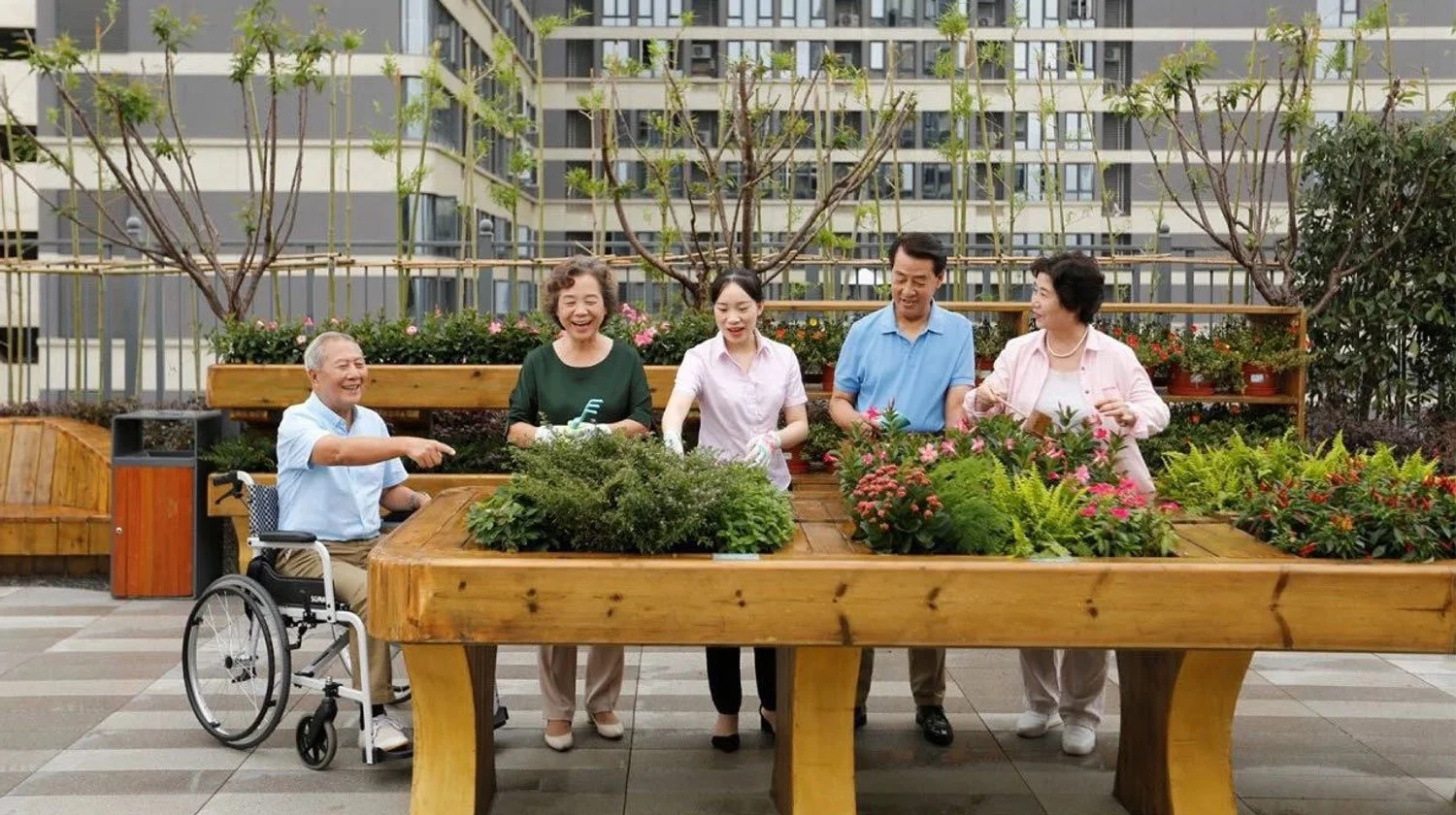
Yinian Rooftop Garden for Seniors
Accessibility as civic infrastructure
There is a tendency to view accessibility as an additional project cost. In reality, inaccessible environments often create far greater social and economic costs over time.
When people cannot comfortably walk through their neighbourhood, visit local centres or access public facilities, communities become less connected and less resilient. Participation declines. Social isolation increases. Physical activity decreases. Accessible public spaces function as civic infrastructure in the same way roads, drainage systems and utilities do. They enable communities to operate effectively.
At Nangle Landscape Architecture, we increasingly see councils and agencies recognising accessibility as a core component of successful place outcomes rather than a compliance exercise. Projects that prioritise inclusive movement, comfort and usability tend to deliver stronger long-term value for communities.
Designing for everyone
Perhaps the most important shift is recognising that accessibility is not about designing for a minority. At different stages of life, almost everyone experiences temporary or permanent changes in mobility, perception, cognition orphysical capacity.
The question is not whether accessibility matters.
The question is whether the environments we create acknowledge the diversity of people who use them. The most successful public spaces do not announce themselves as accessible. They simply work. They allow people to move confidently, participate independently and feel welcome within the life of a place. That outcome goes well beyond compliance. It represents the fundamental purpose of good design.