Designing with Water in Mind: Integrating WSUD into Transport and Civic Landscapes
When water is treated as an asset rather than a problem, infrastructure corridors can support cleaner catchments, stronger places and lower whole of life costs.
Transport infrastructure reshapes landscapes at scale, but it is not alone. Streets, civic precincts, parklands and renewal areas all influence how water moves through a catchment. Hard surfaces increase runoff, drainage patterns shift, and downstream systems are placed under growing pressure.
For many years, the response was largely concealed: pipes, pits and outlets designed to move stormwater away as quickly as possible. Water sensitive urban design, or WSUD, reframes that approach. Instead of asking how fast water can be removed, it asks how water can be slowed, filtered and integrated into the landscape as a performing layer of infrastructure.
Across NSW, this shift is becoming central to how public environments are planned and delivered. Agencies are balancing flood management, environmental performance, maintenance realities and design quality, recognising that stormwater is inseparable from long-term asset resilience. Guidance such as Transport for NSW’s WSUD framework reflects this broader evolution toward treating water as part of place, not simply a drainage task.
At Nangle Landscape Architecture, we view WSUD as a design mindset as much as a technical system. Working across transport corridors and civic landscapes, we consistently see that when water is considered early and collaboratively, projects move beyond compliance to deliver cooler microclimates, healthier ecologies and more legible public spaces.
What WSUD really means in transport projects
At its core, WSUD integrates water cycle management into planning, design and construction. On transport and civic projects, the main interaction with the water cycle occurs through stormwater. Construction increases impervious surfaces, which increases runoff volume and reduces water quality entering downstream waterways.
WSUD seeks to address this by replicating natural processes within a constructed environment. Instead of concentrating runoff into pipes and discharging it at the edge of a corridor, WSUD encourages capture, infiltration, filtration and detention closer to where rain falls. This approach can improve water quality, reduce peak flows, and help projects fit more sensitively into their context.
Importantly, WSUD is not new. Table drains and vegetated verges have performed similar functions for decades. What has changed is the intent. Today, those systems are being designed deliberately to achieve multiple outcomes: environmental protection, visual quality, safety, amenity and value for money.
Early thinking makes all the difference
One of the strongest messages in the guideline is the importance of early consideration. WSUD is most effective when it is explored at feasibility and concept stages, alongside alignment, cross section and land acquisition decisions. Leaving it until detailed design almost guarantees compromise.
Early planning allows project teams to understand catchment sensitivity, changes in effective imperviousness, available space, soil conditions and maintenance capacity. It also allows WSUD objectives to be aligned with commitments made through environmental assessment, rather than retrofitted later.
From experience working across road, rail and civic projects, Nangle has seen how early landscape and urban design input can unlock opportunities that might otherwise be missed. Alignments that follow contours, verges that double as swales, and medians that provide treatment and shade are rarely accidental. They are the result of early, multidisciplinary collaboration.
WSUD as Infrastructure That Shapes Place
The primary role of water sensitive urban design is environmental performance. Systems are implemented to manage runoff, improve water quality and support long-term catchment health. However, when considered early in the design process, these systems can also contribute meaningfully to the spatial structure of a project. Rather than being concealed or treated as leftover space, stormwater infrastructure is increasingly expressed as part of the landscape framework.
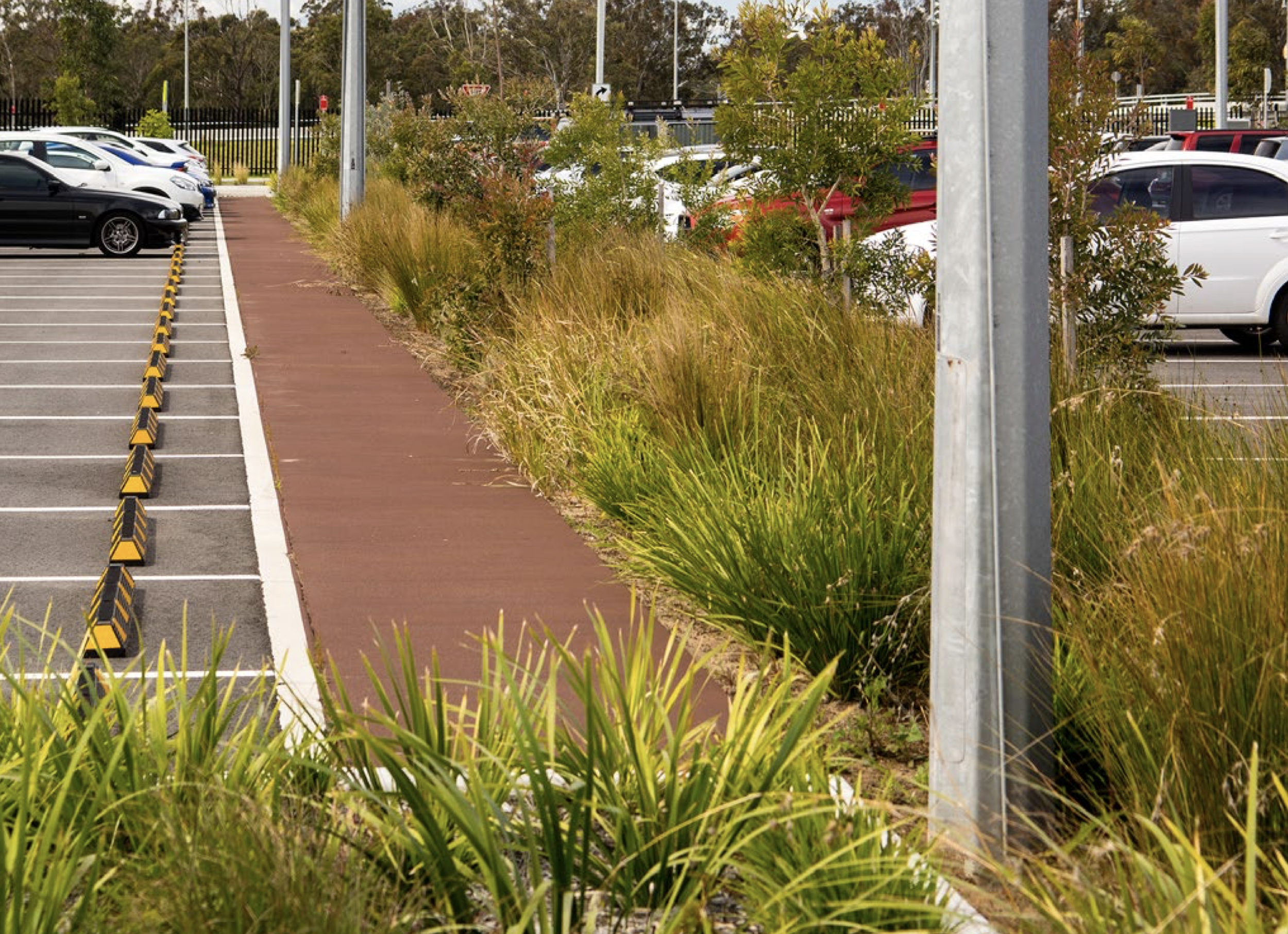
Vegetated swales, bioretention zones, wetlands and permeable surfaces can help define edges, guide movement, moderate microclimate and soften large expanses of pavement. When resolved carefully, they are understood as landscape first while continuing to perform critical hydraulic functions. Many of the qualities associated with strong urban design emerge naturally from this approach. Clear grading supports passive surveillance, shallow profiles improve recoverability, and well considered planting can reduce reliance on fencing or visually intrusive barriers. These outcomes are rarely the starting point, but they are consistent byproducts of systems that are legible, maintainable and grounded in sound spatial thinking.
There is no universal WSUD detail. Dense urban centres, transport corridors, parklands and flood-prone environments each require a calibrated response. Successful projects resist the temptation to standardise and instead align hydrological performance with landscape character and operational reality.
The treatment train approach
Central to WSUD is the idea of incremental treatment, often described as a treatment train. Rather than relying on a single end of pipe device, multiple elements are used in sequence to manage water quality and quantity.
Primary elements such as vegetated swales slow flows and capture coarse sediment and litter. Secondary elements like bioretention swales or basins provide finer filtration and pollutant removal. Tertiary elements, including wetlands or ponds where appropriate, polish water before discharge.
For transport corridors, this approach aligns well with linear forms and space constraints. Distributed treatment close to source reduces the need for large downstream infrastructure and can often lower whole of life costs.
The idea of shaping cities through water is not new. Frederick Law Olmsted’s Emerald Necklace in Boston demonstrated more than a century ago that flood management, ecology and public life can be resolved through connected landscapes rather than hidden infrastructure. Today, WSUD applies this same spatial logic with greater technical precision, arranging systems in deliberate sequences so water is slowed, treated in stages and integrated into place. The terminology has evolved, but the core idea endures: when water is designed as landscape, cities perform better.
Integrated Systems, Designed for Performance
WSUD is sometimes misunderstood as a purely vegetated approach. In reality, the strongest outcomes rarely rely on soft landscape alone. They emerge from carefully integrated systems where planting, landform and engineered components work together. Hard elements such as subsurface drainage, structural soils, rock protection or impermeable liners often perform critical roles that are not immediately visible. When thoughtfully resolved, they support the landscape rather than compete with it.
What matters is not whether a solution is “soft” or “hard”, but whether it is appropriate to its setting.
Dense urban precincts, where space is limited and services are complex, often call for compact interventions such as bioretention tree pits, permeable pavements or engineered filtration systems. In more open corridors, swales, table drains and vegetated basins may achieve the same performance with fewer constructed elements.
The judgement lies in reading the site correctly. Soil behaviour, groundwater, slope, catchment dynamics and maintenance capacity all shape what will succeed over time. Systems that ignore these fundamentals can quickly shift from asset to liability, creating waterlogging, structural stress or ongoing operational burden.
At Nangle, we approach WSUD as a coordinated design exercise rather than a catalogue of devices. When landscape and engineering logic are aligned early, stormwater systems tend to perform better, age more gracefully and integrate more naturally into their surroundings.
WSUD as Functional, Landscaped Infrastructure
One of the most important shifts in contemporary stormwater practice is the recognition that WSUD elements are not decorative landscape features. They are working assets that must perform reliably over time.
Planting sits at the centre of that performance. Vegetation within swales, bioretention systems and basins must tolerate alternating wet and dry conditions, support filtration processes and stabilise soils against erosion. Consistent groundcover is particularly critical, helping to prevent scour, reduce sediment movement and protect hydraulic function.
Species selection should always respond to local climate, soil conditions and the sensitivity of receiving waterways. Indigenous planting is often preferred, particularly where downstream environments are vulnerable to weed invasion. When thoughtfully composed, adjacent trees and shrubs can provide shade, reinforce spatial definition and visually integrate water management systems into the broader landscape. This requires careful consideration of root behaviour, canopy density and tolerance to periodic inundation.
Approached this way, planting is no longer an aesthetic overlay. It becomes functional infrastructure.
At Nangle, WSUD planting is designed with the same discipline applied to any engineered asset, balancing hydraulic performance, maintainability and long term visual quality. This rigour helps ensure systems continue to function as intended well beyond the establishment phase.
Underlying this approach is a broader reframing of stormwater itself. Rather than treating water as something to be removed as quickly as possible, WSUD recognises its potential value. When managed well, stormwater can support passive irrigation, moderate microclimate, contribute to urban cooling and provide habitat within highly modified environments. In some contexts, it may also support non potable reuse strategies.
Seeing water as an asset encourages project teams to think beyond site boundaries and consider catchment scale opportunities. Collaboration with councils, water authorities and adjoining land managers can unlock shared benefits that individual projects cannot achieve in isolation.
When WSUD is conceived as both infrastructure and landscape, the outcome is more than compliant drainage. It is a system that performs technically, strengthens ecological function and contributes positively to the character and resilience of place.