Planning Sydney for Growth That Feels Like Home
Sydney is growing fast. The Sydney Plan sets out how land use, infrastructure and place can work together to support a larger, more liveable city.
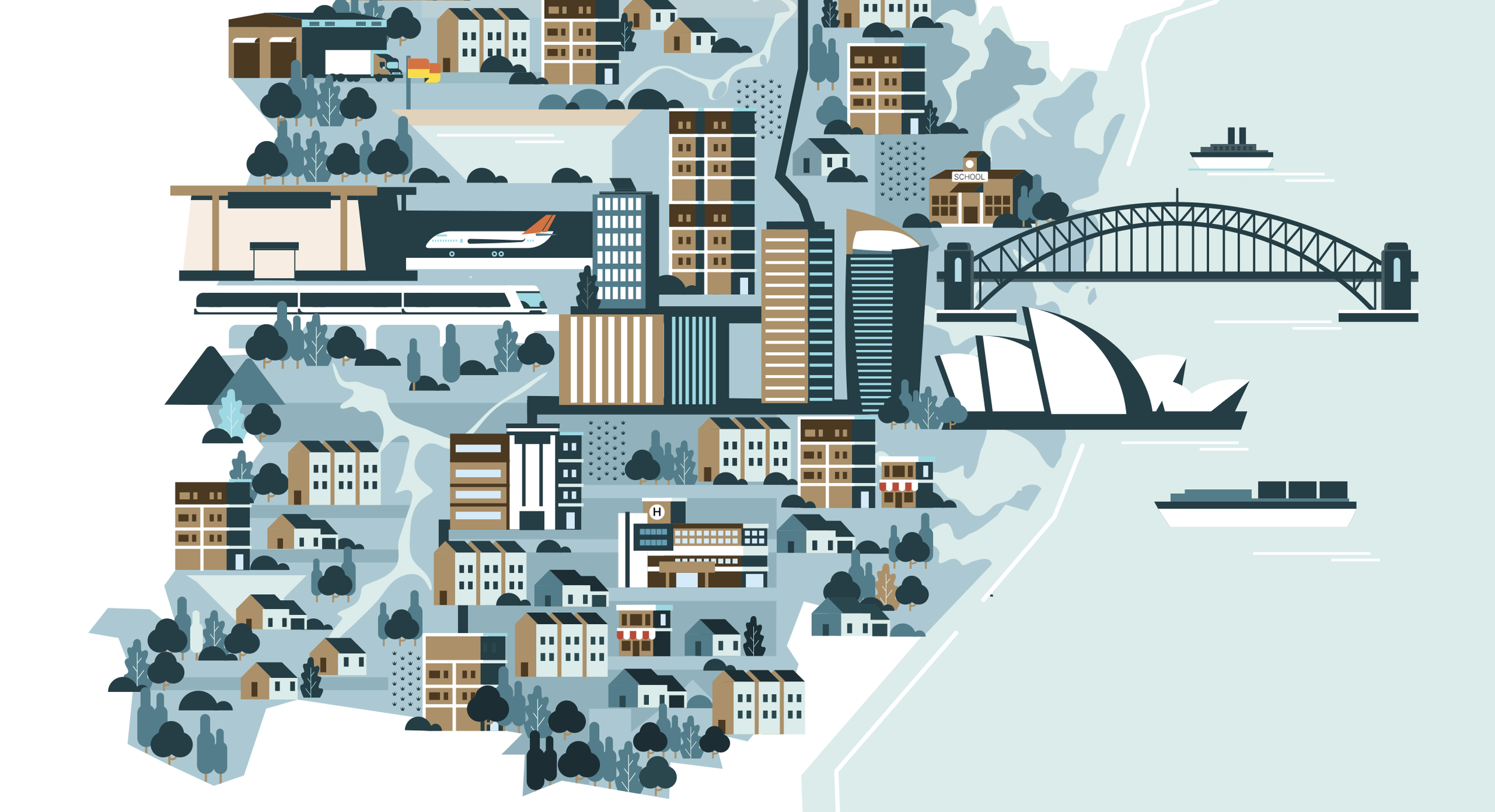
Over the next 20 years, Sydney's population is projected to grow by around 1.2 million people. the scale of change ahead is substantial. How that growth is managed will determine not just where people live and work, but how Sydney feels as a place to move through, gather in and belong to.
The draft Sydney Plan is the NSW Government’s response to that challenge. As the first of a new generation of regional plans, it sets out a clearer, more practical framework for aligning land use, infrastructure and investment decisions across the 33 local government areas that make up the Sydney region. More importantly, it signals a shift away from abstract vision setting towards actions that can be delivered on the ground.
For practitioners working across planning, design and delivery, this shift reframes transport, housing and public space as a single, integrated system rather than separate disciplines.
A simpler plan with sharper priorities
The Sydney Plan replaces the Greater Sydney Region Plan and its associated district plans, bringing strategic planning into a single, streamlined framework under the Department of Planning, Housing and Infrastructure. Structured around seven state priorities, Aboriginal outcomes, housed, prosperous, connected, resilient, liveable and coordinated, the Plan applies these themes spatially to guide growth across the region.
What stands out is the emphasis on coordination. The Plan is designed to inform local strategic planning, infrastructure prioritisation and public and private investment decisions simultaneously. Councils are expected to align their Local Strategic Planning Statements and Local Environmental Plans with the Sydney Plan, creating a clearer line of sight between state intent and local outcomes.
For those of us working at the intersection of strategy, landscape and public domain delivery, this alignment is long overdue.
Growth that is more than numbers
At its core, the Sydney Plan is about accommodating growth fairly and equitably. Housing targets, low and mid rise reforms and transport oriented development all feature prominently. But the Plan also recognises that density alone does not create liveable places.
The challenge is particularly evident across Greater Sydney’s major centres, including Parramatta, Liverpool, Blacktown, Penrith and Macquarie Park, where housing growth must be matched by investment in public space, transport and community infrastructure.
Access to jobs, services and open space is central. The Plan promotes a stronger network of employment centres so people can live closer to work. It prioritises growing and connecting public open space and embedding resilient and sustainable urban design principles to manage heat, flooding and other natural hazards.
This is where land use planning and landscape thinking converge. For many practitioners, open space has long been understood as essential rather than ornamental. The Draft Sydney Plan acknowledges this, explicitly framing open space as critical infrastructure for health, cooling, social connection and resilience..
In our experience supporting councils across Greater Sydney, early consideration of public domain and landscape frameworks often determines whether growth areas mature into places people value or environments they simply tolerate.
Canopy, climate and comfort
One of the clearest signals in the Sydney Plan is its support for urban greening. The NSW Government has set a target to increase tree canopy to 40% by 2036, recognising that health and cooling benefits begin at around 30%. Councils will be responsible for setting canopy targets across both public and private land, supported by a forthcoming Urban Greening Guide.
This matters in a city facing rising temperatures and increasing heat stress. Tree canopy, permeable landscapes and connected green networks are among the most effective tools we have to manage urban heat and improve comfort at street level.
Landscape architecture brings a long term stewardship lens to these challenges. Balancing canopy growth with housing delivery, infrastructure constraints and ongoing maintenance requires careful planning and realistic design responses. This is work that benefits from collaboration between planners, engineers and designers from the outset.
Infrastructure that supports place
The Plan also places strong emphasis on infrastructure sequencing and coordination through the Urban Development Program. Roads, schools, health facilities and open space are to be planned alongside housing, not retrofitted later. Under the Draft Sydney Plan, the UDP is positioned as a delivery tool, not just a monitoring exercise. It reinforces the principle that:
housing growth should be sequenced with infrastructure, not approved in isolation
open space and social infrastructure are essential components of growth, not optional extras
infrastructure planning needs to be coordinated across government, rather than agency by agency
Infrastructure Opportunities Plans will guide state investment decisions and help councils align their local programs with regional priorities. This approach recognises that timely infrastructure delivery is essential to maintaining liveability as growth accelerates.
For design practitioners, this creates an opportunity to influence outcomes earlier. When infrastructure is conceived as part of a broader place framework, rather than a standalone technical exercise, streets, parks and centres are more likely to function as cohesive, human scaled environments.
Nangle often operate in this space, working alongside councils and agencies to translate strategic intent into public domain outcomes that support both growth and everyday use.
Aboriginal outcomes and enduring connections to Country
The Sydney Plan explicitly acknowledges the spiritual significance of land and the importance of Aboriginal culture and economic self determination. Planning processes are expected to promote Aboriginal outcomes and recognise enduring connections to Country.
This is not an add on. It is a fundamental part of how land use planning should be approached in a city shaped by tens of thousands of years of custodianship. Meaningful engagement, early involvement and respect for cultural knowledge are essential to delivering places that are inclusive and grounded in their context.
From plan to place
The strength of the Sydney Plan lies in its focus on delivery. It identifies actions to be implemented over the next five years, aligned with a 20 year vision. It removes layers of duplication and provides a clearer framework for decision making.
But plans do not build cities on their own. Outcomes will depend on how well councils, agencies and practitioners work together to apply these directions on the ground.
For landscape architects and urban designers, this is an opportunity to help ensure growth is shaped by more than yield and efficiency. Streets, parks and public spaces are where the Plan’s priorities become tangible. They are where liveability, resilience and connection are either realised or lost.
As Sydney grows, the challenge is not simply to house more people, but to create environments that support daily life, adapt to climate and foster a sense of belonging. The Sydney Plan provides a strong foundation. Thoughtful, coordinated design will determine whether its ambitions translate into places that endure.
Local planners, councils, developers, designers and landscape architects all have a role to play in engaging deeply with the draft, testing its assumptions and providing practical feedback to ensure the final plan delivers meaningful, place-based outcomes across Sydney.
Read the draft Sydney Plan and have your say here.